The records. Every file the Department has produced, 135 so far, is published at middlesexgazette.org/records/tax-prr-november-2026/, with five alterations the collection's index lists: one personal phone number blacked out, mail-routing headers removed, tracking tokens cut from links in the text renderings, five non-office phone numbers in signature blocks replaced, and one Outlook item given as text. Every quotation below links to the record it comes from, or to the outside source.
On November 13 the Vermont Department of Taxes sent the Gazette 19 more files on Commissioner Bill Shouldice's commentary. The records show Department employees writing the op-ed, and arranging its publicity, to attack a candidate's proposal, and timing it to the gubernatorial debate.
The state officials' own words carry the claim. The analyst who wrote the draft, on October 19: "candidates are running policy proposals based on what's essentially a meme." He never says what the meme is. The memes in the record are the Commissioner's: on October 14 he texted the analyst ten social-media posts, screenshots of short videos ranking states by millionaires, taxes, wages and welfare, as the context for the "wealth tax" argument. The Gazette's reading: the Commissioner reached for social-media posts because the Department's own data does not say that "there are no 'wealthy' people left." Counting the income tax, the property taxes and the taxes on spending, as the Gazette reported on October 27, the average top-1-percent filer, on $1.56 million a year, pays a smaller share of income than the median Vermont household does on $83,000, and a household at the top-1-percent line pays less than one earning a quarter as much. The Deputy Commissioner, the same morning, proposing a statement from the Commissioner "in response to the week's candidates' debate," and checking that the idea still suited the Governor's office. The Commissioner's principal assistant, in a margin comment on the draft: "part of the power of this op-ed is utilizing -- and debunking -- the verbiage being used by advocates and candidates." The same assistant, sending the final draft to the Governor's office on October 20: "an op-ed debunking the 'wealth tax' rhetoric that's been circulating in the state." And that afternoon: "The gov is scheduled to go on the Morning Drive tomorrow morning and will tease some of these talking points."1
The candidate was Amanda Janoo. The proposal was to recoup, from Vermonters earning over $250,000, the federal tax cut they had just received. The debate was Vermont Public's, on Wednesday, October 21, at 7 PM. That morning the Department waited on the fifth floor ("if they don't answer, he said to just let it rip"), got its clearance at 11:38 AM ("Just got the clear from 5th floor and Bill. Sending.") and pitched the piece to VTDigger seven minutes later. On the stage that night Janoo made the proposal and the Governor answered with a state ranking that matches one of the ten social-media screenshots the Commissioner had sent his analyst a week earlier.
The State's own rule on this is Policy 5.7 of the Department of Human Resources, "Political Activity," which applies to "All classified, exempt, and temporary, employees with the Executive Branch of the State of Vermont." An employee may not "Use his or her official authority or influence for the purpose of interfering with or affecting the nomination or election of any candidate for public office," which includes "Using his or her official title; government funds, equipment, supplies or personnel while participating in political activity," and may not "Engage in political activity during the employee's working hours." Political activity is "activity directed toward the success or failure of a political party, candidate for partisan political office, or partisan political group." The policy's stated purpose is "to avoid conflicts of interest and the appearance of conflicts of interest," and it bars outside activity that "would create a conflict of interest or the appearance of a conflict of interest or abuse of position." The Department has told the Gazette it has no policy of its own on commentaries or election-period communications, and Policy 5.7 was not among the records it produced.2
The files themselves are a screenshot of the Commissioner's text messages to his analyst that shows their date; the ten images he attached to them; four emails from the morning of October 19; two replies from the editor of the Waterbury Roundabout; and VTDigger's automatic reply to the pitch. The Commissioner set the argument on October 14, 92 minutes after the fifth floor's encouragement. The analyst's first draft came with a second version he described as one "where Ena asked Claude to improve some things."
1. October 14, 12:24 PM
The first story began on October 14 at 10:52 AM, when Deputy Commissioner Rebecca Sameroff told a Department chat: "Bill just got a lot of enthusiasm from the 5th floor for working up a wealth tax op ed." The fifth floor is where the Governor's office and the Secretary of Administration sit. The Department has since said the message "was sent after the regular weekly meeting of Ms. Sameroff, Ms. Clark and Mr. Shouldice." Sarah Clark is the Secretary of Administration.3
At 12:24 PM the same day, the Commissioner texted Jake Feldman, the Department analyst who would write the draft. The Department produced the thread on November 10 with the date hidden behind the contact's name; the screenshot it sent on November 13 shows "Wed, Oct 14 at 12:24 PM."4 He sent ten social-media screenshots and this:
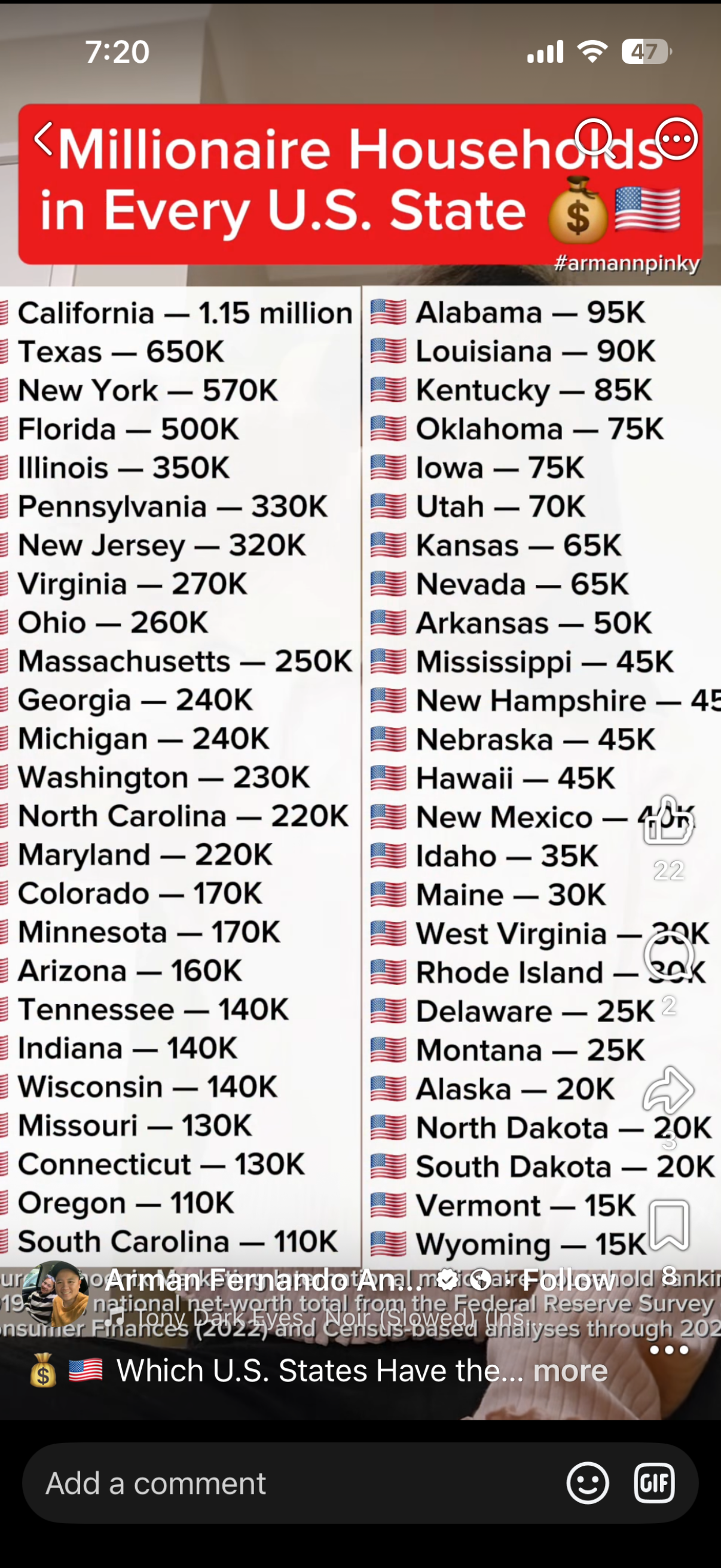
Millionaire households by state
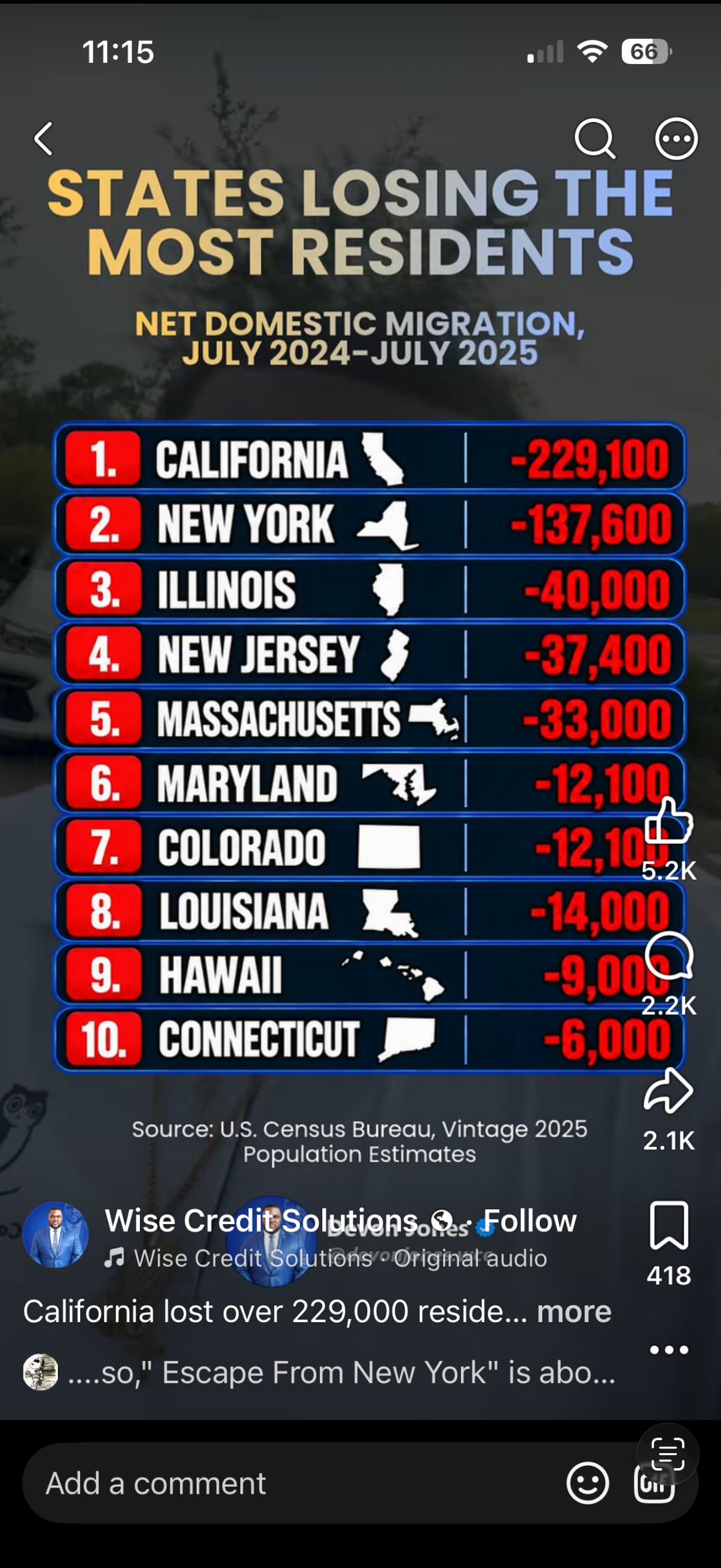
States losing the most residents
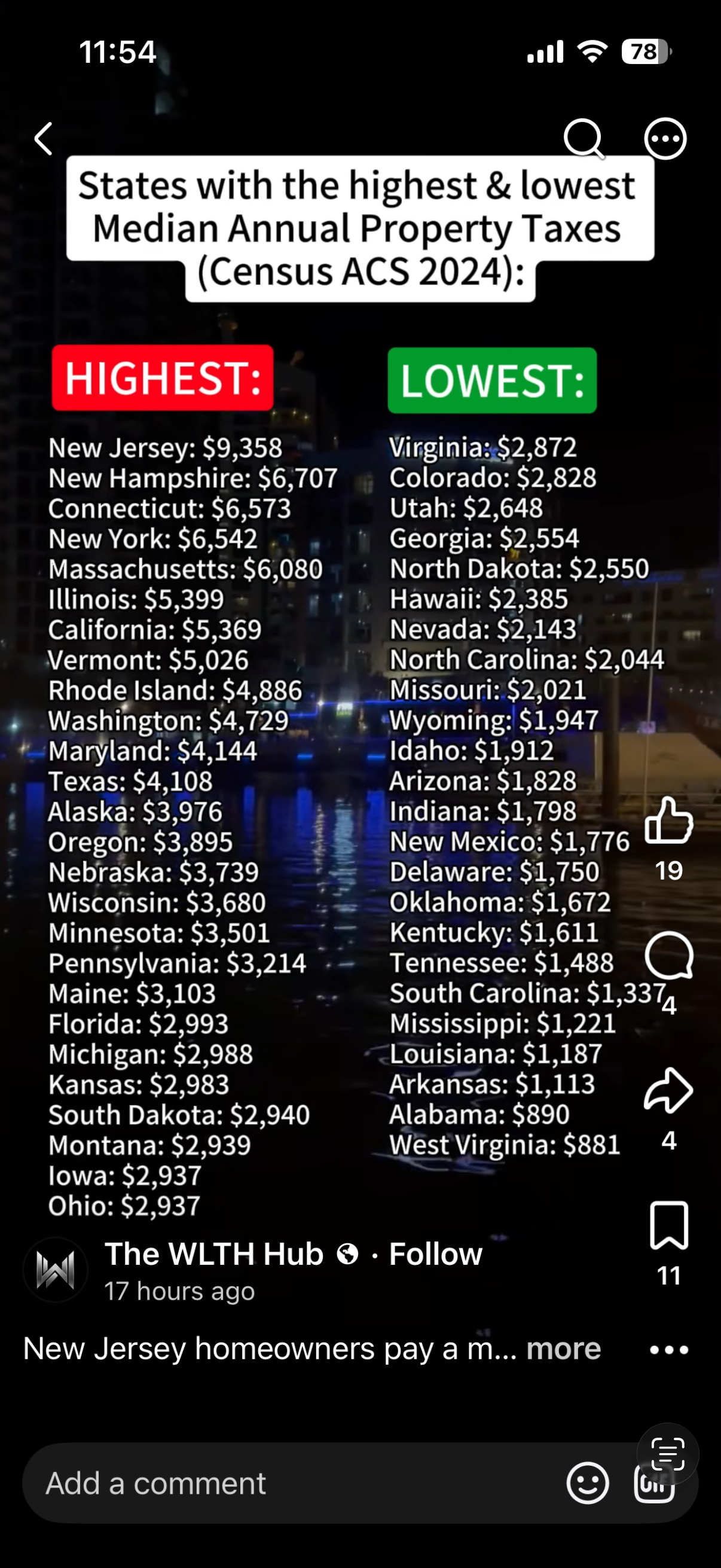
Median property taxes by state
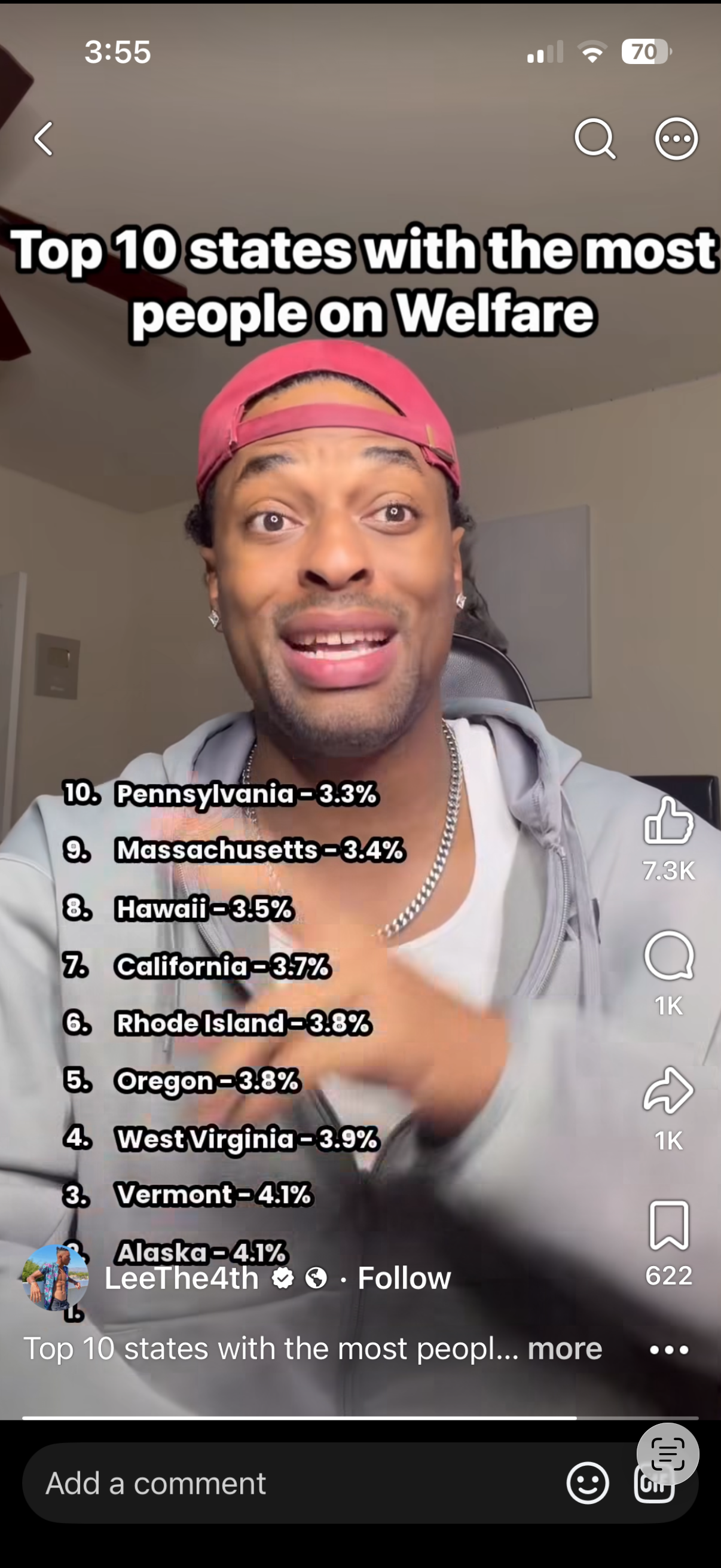
Share of people on welfare, by state
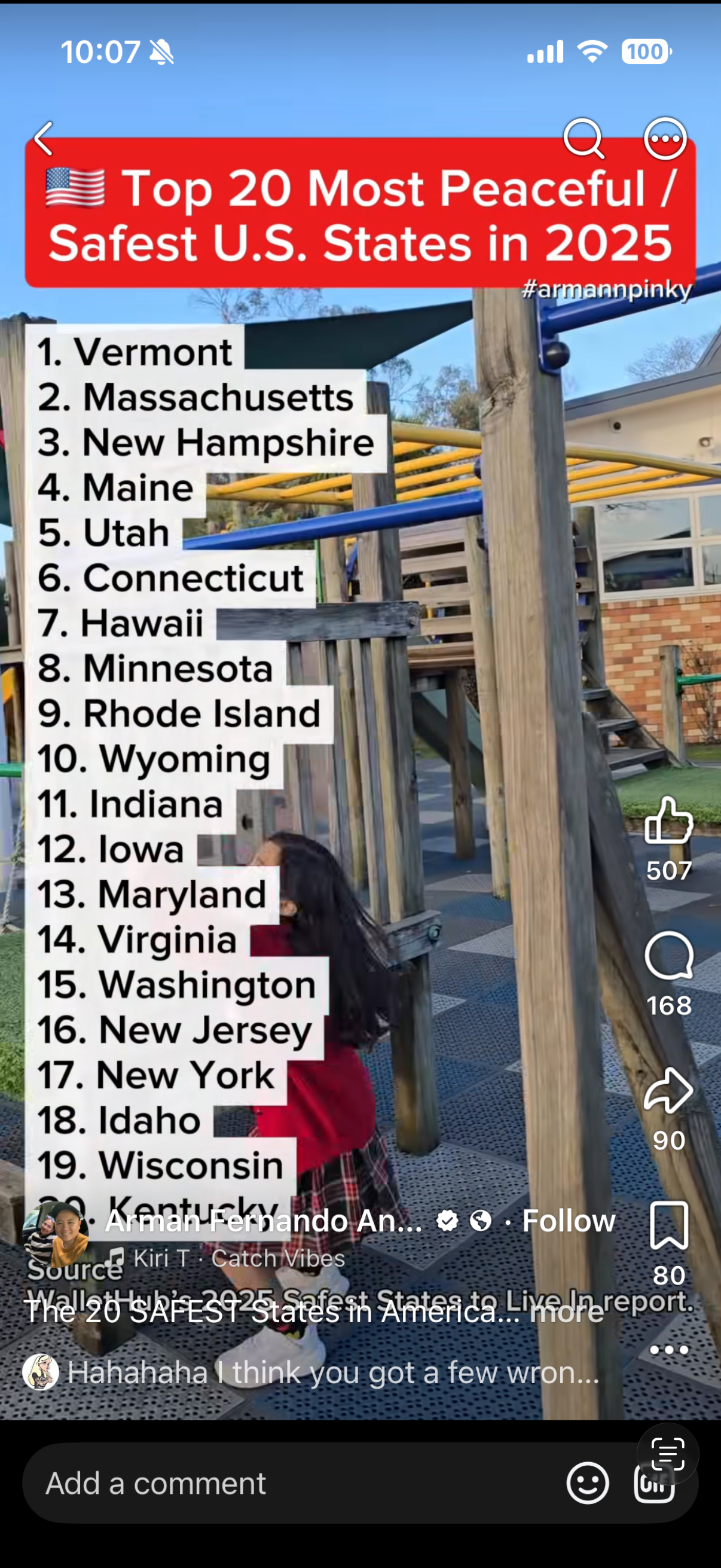
The twenty safest states
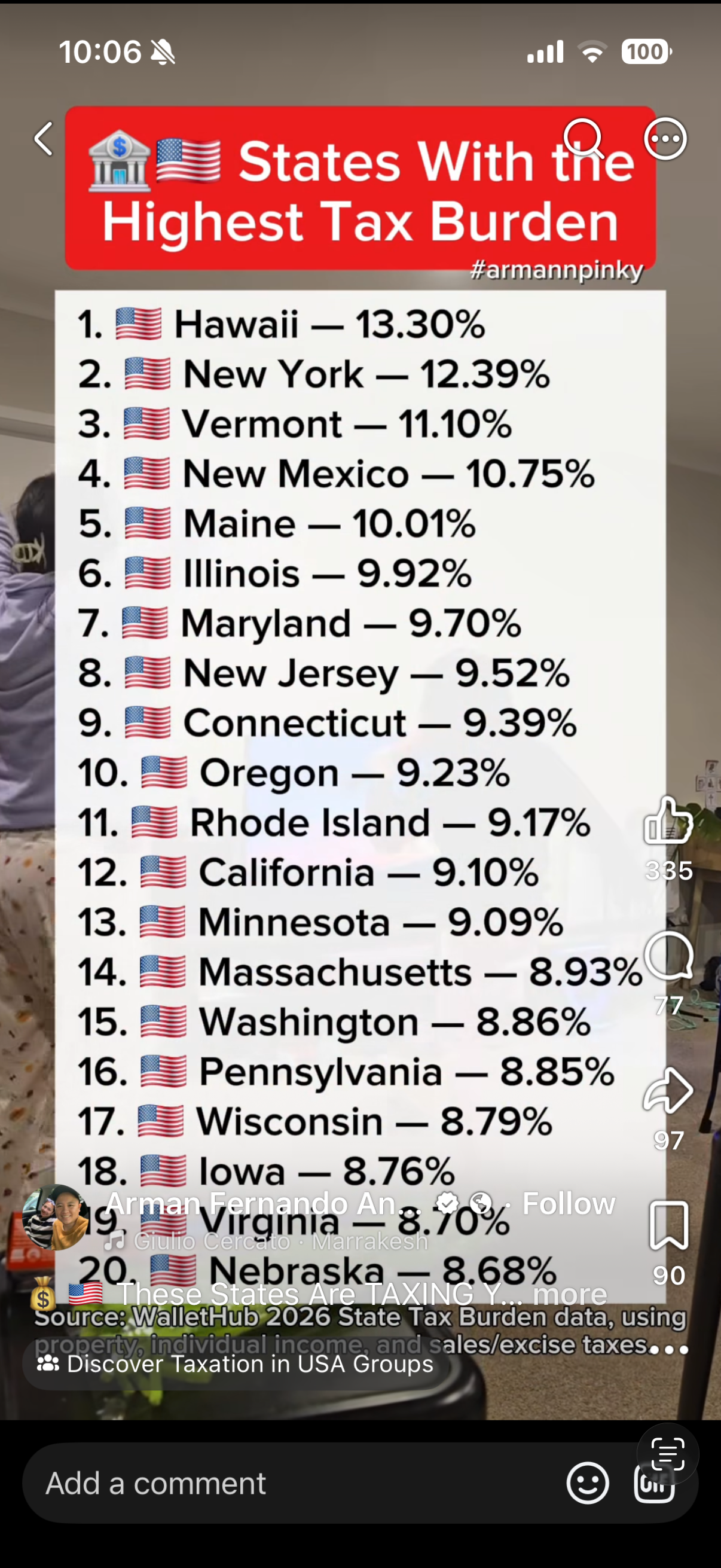
States with the highest tax burden
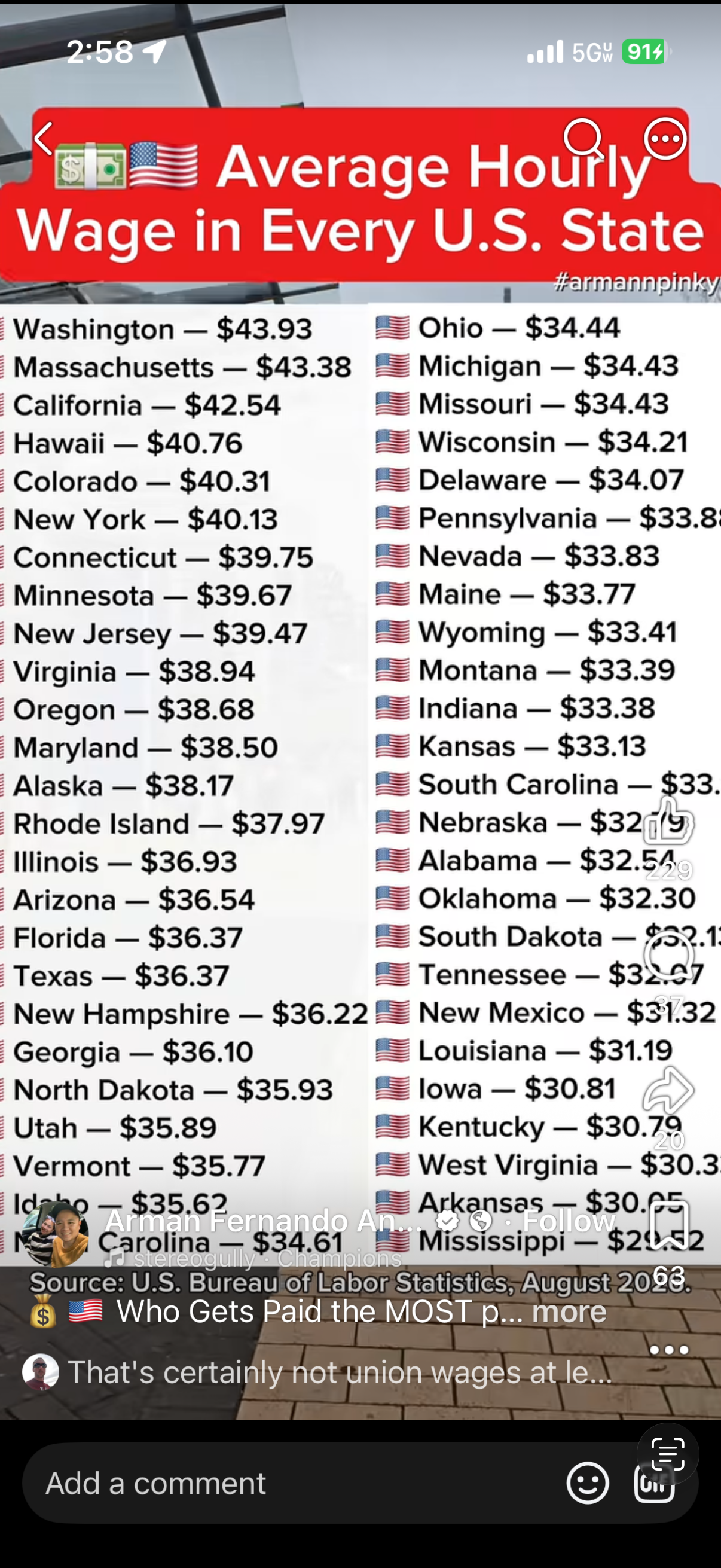
Average hourly wage by state
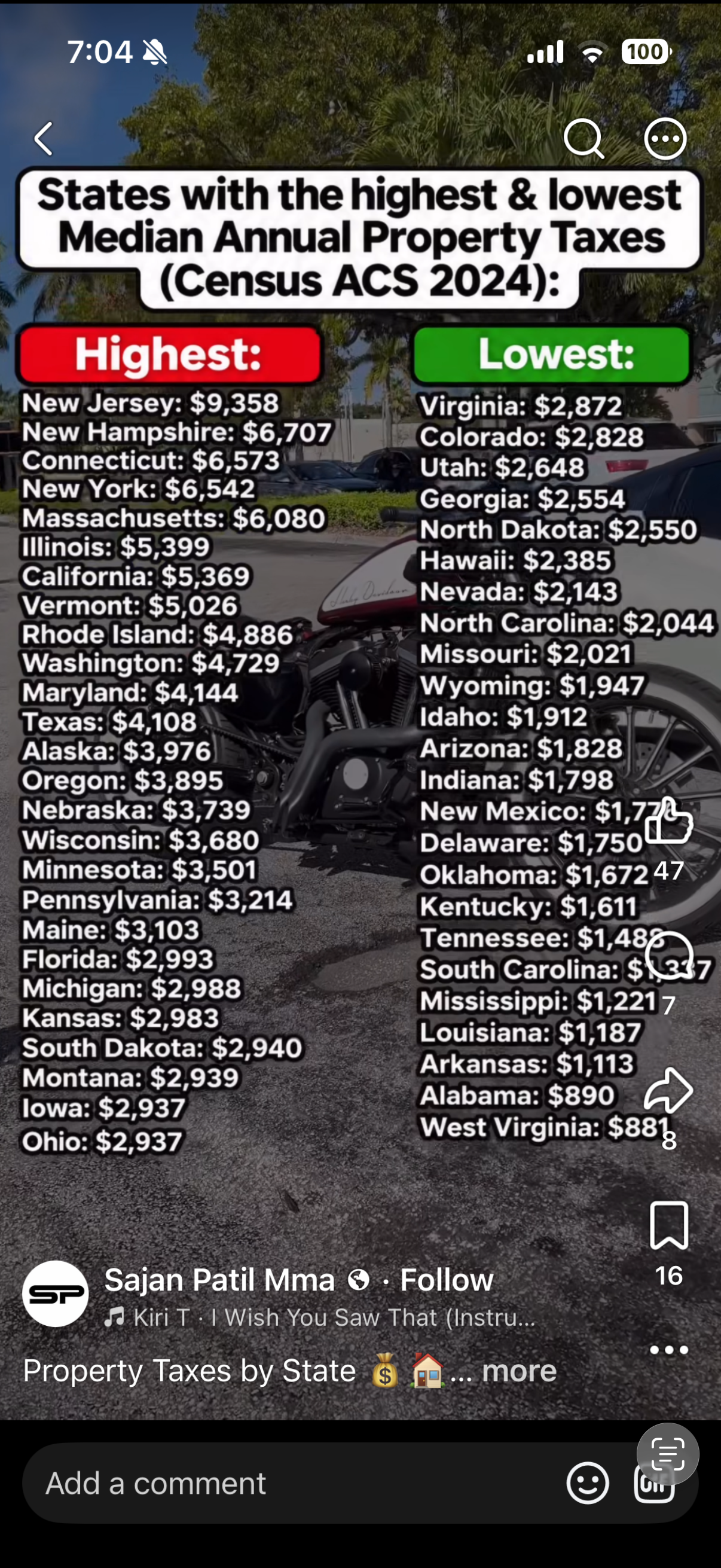
Median property taxes by state, second copy
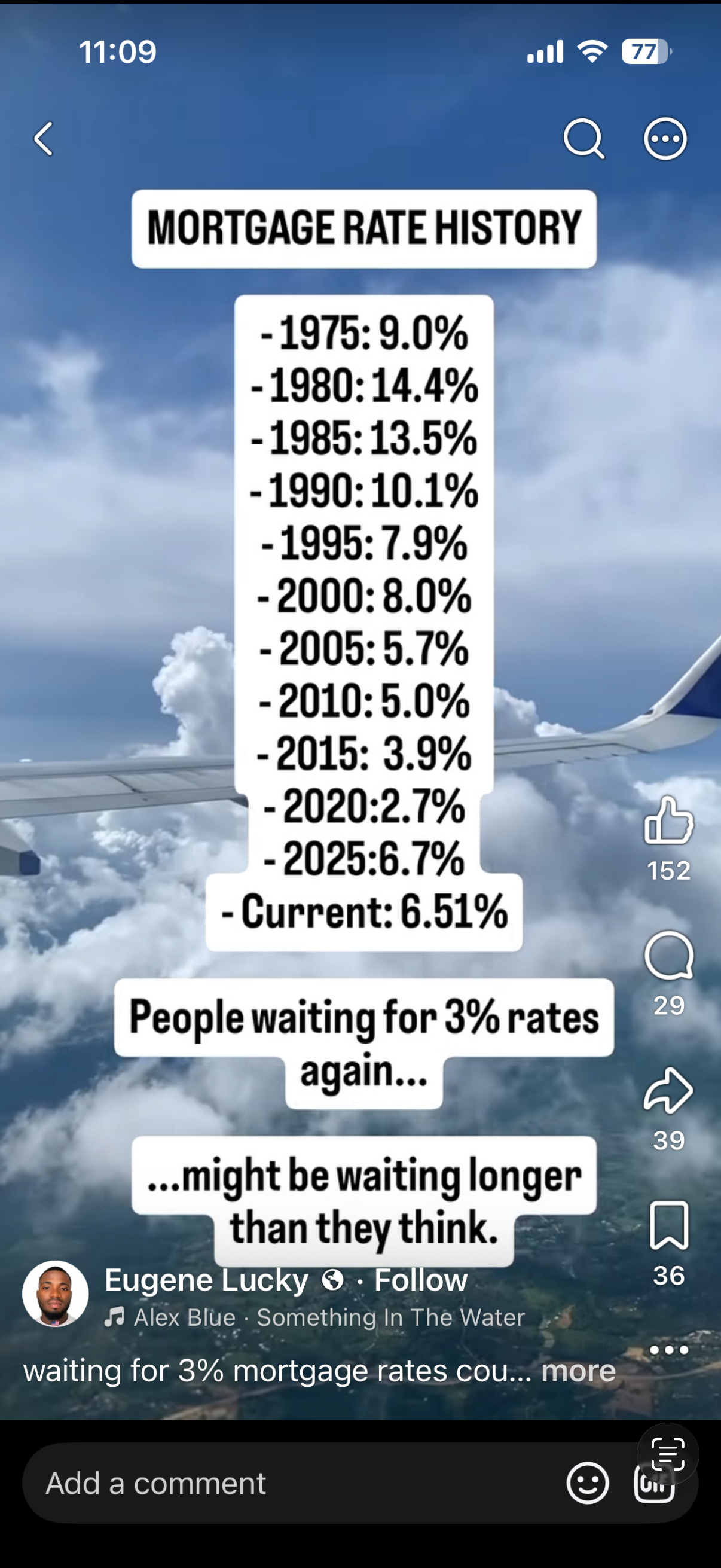
Mortgage rate history
The ten screenshots are from short-video accounts. None cites a source the reader could check beyond a caption line, and four carry the same hashtag. Millionaire households by state, with Vermont at 15,000. States losing the most residents. Median property taxes by state, from two different accounts, with Vermont eighth highest at $5,026. The ten states with the most people on welfare, with Vermont third at 4.1 percent. The twenty safest states, with Vermont first. States with the highest tax burden, with Vermont third at 11.10 percent, captioned as WalletHub data. Average hourly wage by state, with Vermont at $35.77. A list of mortgage rates since 1975. And one post titled "The Stocks That Will Make You Rich Before 2027."6
Feldman answered with a thumbs-up. The Department says that is "the end of the conversation related to the op ed."7
2. October 19, 6:44 AM: two drafts
Feldman wrote the first draft over the weekend of October 17 and 18.8 On Monday, October 19 at 6:44 AM he sent Sameroff and Sarah Mearhoff, the Commissioner's principal assistant, two files: "Here's my original op-ed (D0) and also a version where Ena asked Claude to improve some things (D0_A). Hopefully between the two there's a useful starting point for us."9 The Department produced both files on November 3 without this email. The second file was created at 6:41 AM that morning and carries two minutes of editing time in its properties. Its headline reads "Before we spend the '$57,000 tax cut,' let's make sure it exists." About half of the original's wording carries over into it.10 The records do not say who Ena is.
Sameroff replied at 10:32 AM: "As usual…..LOVE your work. Found yours easier to follow than Claude's, btw!" Feldman at 10:37 AM: "Claude didn't decide to mention any of that, lol".11
The same two emails say what the piece was for.
Sameroff, 10:32 AM: "Today I'd like to confirm with Amanda W and Maulucci that this idea is still sounding like a good idea to them. SM and I can discuss at our check-in in a few. Earlier this morning, Kate C. flagged that our op-eds haven't been getting pickup and that we could consider trying some other channels to get better uptake. Offer an exclusive? Perhaps prepare a 'statement,' published on our website, from the Commissioner 'in response to the week's candidates' debate,' or something less political? I think this is a really strong narrative – flows so so nicely – so I'm already a little attached to the op ed format."11
Amanda Wheeler and Jason Maulucci are in the Governor's office; the first story showed Wheeler clearing the draft the next morning ("This is good to go from my perspective"). Kate C. is Katelyn Connizzo, the Department's communications director. The week's candidates' debate was Vermont Public's debate between Governor Phil Scott and Amanda Janoo on Wednesday, October 21, at 7 PM, the day the pitches went out.12
Sameroff went on: "Jake, do you think we need to round out our myth busting by acknowledging that there is some 'new' tax relief in OBBBA, just not the big splash that's getting reiterated in talking points and news articles?"
Feldman, 10:37 AM: "I think this is a big deal (saying candidates are running policy proposals based on what's essentially a meme) so it would be super cool if it showed up somewhere people might actually see it, such as Digger. But I am ok with whatever people decide is best." (Bold is the Gazette's emphasis.)
Sameroff, 10:52 AM: "AGREED on all fronts – will chat with Sarah about digger-oriented strategy."13
Feldman is a Senior Fiscal Analyst in the Office of the Commissioner, a state employee paid by taxpayers.14 The Gazette's concern is the one it stated in the first story, now in the Department's own words: a Department analyst was writing, about two weeks before the election, to shape how voters saw what a candidate was proposing, and the Deputy Commissioner was checking with the Governor's office that the idea still suited it.
4. The candidate and the proposal
The drafts name no one. The original says: "With election season here, taxes are all over the news and social media and sometimes it's hard to know what's accurate." And: "That misleading $57,000 federal tax cut figure mostly comes up in campaigns that aim to make Vermont's wealthiest pay more state income taxes." The Claude version says: "posts and campaign pitches have claimed that the top 1% of Vermonters just got an average federal tax cut of $57,000." And: "The federal tax cut that today's campaigns want to capture is the same one Vermont responded to in 2018." And: "That matters for anyone making promises this fall."15
One campaign was making that proposal. At the Vermont Public debate on October 21, the moderator put it to Janoo: "So, your platform hinges on a number of new tax proposals, including raising income taxes on the wealthiest Vermont. In June, you told the Vermont Public that you favored an 8% surcharge on incomes above $500,000, 2% surcharge on incomes above $250,000."
Janoo: "as I've been traveling around the state, I've been asking folks, you know, 'how many people here actually make $250,000 or more?' It's not normally a ton, but then I'll say, 'Okay, well, would you be willing to contribute the equivalent of the amount you just got back from the Big Beautiful Bill in terms of tax cuts, in order to ensure that everybody, not only in your community but in the state, could have access to a good local doctor and mental health provider?'"
Later: "the proposal that really just looks at, again, recouping the tax cuts for the wealthiest Vermonters, equivalent to the amount that they're getting from the Big Beautiful Bill would generate about $260 million."16
That is the proposal the Commissioner's text of October 14 describes as moving "the definition of 'wealth' down to Family AGI of $250k," and the one the drafts call the thing "today's campaigns want to capture."
The Governor's answer that night included: "Our tax burden is third highest in the nation. Hawaii is first, New York is second, Vermont is third." One of the ten screenshots the Commissioner had sent his analyst a week earlier is a list headed "States With the Highest Tax Burden," captioned as WalletHub data: Hawaii first, New York second, Vermont third.17
5. The pitch, and VTDigger's reply
Mearhoff pitched VTDigger at 11:45 AM on October 21, seven minutes after the Department chat recorded "Just got the clear from 5th floor." One minute later VTDigger's opinion desk answered automatically: "**PLEASE NOTE: As a nonprofit organization, we are unable to run pieces by candidates standing in the upcoming November 2026 elections. This also applies to letters and commentaries in support of individual candidates.**" (The asterisks are VTDigger's own.) The reply adds: "We will not contact you to let you know whether or not we will run your piece." No other reply from VTDigger is in the records, and VTDigger is not among the outlets the Department lists as having run the piece.18
The Waterbury Roundabout's editor replied at 12:11 PM: "Thank you for sending this along (and to Bill for writing it!). We love being able to give readers context these days." At 12:48 PM: "It will be on the Opinion page and we're also cross-posting on an Elections page too to have all election-related posts in one spot."19
The piece ran in the Manchester Journal on October 25, in the Times Argus and Rutland Herald on October 27, in the Brattleboro Reformer and the Caledonian Record, on the Roundabout, in the Community News Group papers, and on the Department's website on October 27.20
6. The principal assistant
Mearhoff ran the press for the piece: the pitches, the follow-ups, the "Op ed published!" email of November 2. Her path to that desk is on the public record. Until December 2024 she was VTDigger's Statehouse bureau chief and its lead political reporter. On January 2, 2025 she started as director of advocacy and communications at the Associated General Contractors of Vermont, the construction trade group, representing "the interests of Vermont's construction workers and developers in Montpelier."21 The Department's own biography calls her "a recent addition to the Tax Department" who "liaises between the Department, Governor's Office, and Legislature" and "leads media relations between the Tax Department and Vermont press corps."22
On October 29, two days after the piece was posted, she texted Sameroff about a reporter: "He knows I'm at ACCD now." The state's payroll snapshot of October 30 lists her at the Agency of Commerce and Community Development.23 On November 13 the Department told the Gazette she "is no longer with the Tax Department, and her emails are no longer available to the Department"; the Agency of Digital Services recovered the eight emails in this set. She had forwarded two emails on the commentary to the Department's lawyer from that mailbox on November 2.24 The records do not say when she was hired by the Department or why she moved.
7. What the Department has said since
The Department's lawyer, Will Baker, has answered the Gazette's questions in four letters. He wrote that the Department has no policy on commentaries, its website, social media or election-period communications: "As far as Department policies, there are no responsive records." It has two standard operating procedures on correspondence and the website that "were over ten years old and have been retired."25
He wrote that the calendar entry for the October 14 meeting "is not responsive to your request," that written confirmation that staff searched their personal phones is "not required by the Public Records Act," and, of the one email the Department withholds as attorney-client privileged, that "We have provided everything we are going to provide as far as the confidential communication." The Department has named the two correspondents, its communications director and its lawyer, and declines to give its date or subject.26
Five documents the Department said on November 3 it would finish reviewing by November 13 are, as of that day, "under review with another agency." The agency is not named and no new date is given.27
8. The rule, and who enforces it
The federal rule is the Hatch Act. Congress has regulated the politics of federal employees since the Pendleton Act of 1883, when the Civil Service Commission's first rule barred classified employees from using "their authority or influence to coerce any other person or interfere with an election." In 1939 Congress passed "An Act to Prevent Pernicious Political Activities," the Hatch Act, which "codified Rule 1's ban on active participation in political management or political campaigns and extended its coverage to include nearly all federal employees." In 1940 it "was extended to cover state and local employees who work on federally financed projects." The Reform Amendments of 1993 let most federal employees take part in politics off duty. The Modernization Act of 2012 "expanded the available penalties for violations of the Act and allowed for covered state or local employees to run for partisan elective office so long as the federal government did not fund the entirety of their salary." The Supreme Court upheld the Act against First Amendment challenges in 1947 and 1973. The U.S. Office of Special Counsel enforces it.28
Almost every state has followed. The Constitution Annotated, Congress's own commentary on the Constitution, says: "All the states have adopted laws patterned on the Hatch Act," citing the Supreme Court's 1973 decision in Broadrick v. Oklahoma. The Office of Special Counsel puts it as "Nearly every state, many localities, and D.C. have ethics rules that govern the political activity of their employees," and adds that it keeps no list of them.29
Vermont has no statute that does what the Hatch Act does. What it has is in three places, and each of them ends at the Governor's own personnel department. The first is Policy 5.7, quoted above: a personnel policy, not a law. The personnel chapter's enforcement section, 3 V.S.A. § 315, says that "The Commissioner of Human Resources, with the approval of the Governor, may institute and maintain any action or proceeding to secure compliance." The second is a merit-system principle in the personnel statute, "assuring that employees are protected against coercion for partisan political purposes and are prohibited from using their official position for the purpose of interfering with or affecting the result of an election or a nomination for office." It applies to the classified career service; department heads, their deputies and the Governor's office staff are outside it. The third is the State Code of Ethics, which requires a public servant to "comply with any other applicable rules or policies established by executive order, agency rule, or policy," and the State Ethics Commission, which accepts complaints. On a complaint that a personnel policy was broken, the Commission's Executive Director "shall refer the complaint to the Commissioner of Human Resources." The Commission's own power to investigate and hold hearings is in the statute with an effective date of July 1, 2028.30
A bill to put the rule in statute, S.251, was introduced in the Senate in January 2024. It would have made interfering with an election through official position an offense with a fine and jail time, enforced by a State's Attorney or the Attorney General. It was referred to the Committee on Government Operations on January 11, 2024, and the Legislature's record of it shows no hearing and no witness. The Gazette's view: a personnel policy, a principle that covers part of the workforce, and an ethics code that sends the complaint back to the Governor's department make one of the weakest arrangements in the country, and the hardest to enforce against the people at the top of it.31
The Legislature that convenes in January can change that without the Governor. Vermont Public, the day after the election: Democrats "are resurgent in the Legislature, where they'll enjoy veto-proof supermajorities in both the House and Senate." Republicans lost 18 House seats, and Senate Republicans "will see their numbers fall from 13 to eight." Governor Scott won a sixth term. The bill text is ready to be refiled. The votes are there, if anyone cares to use them.32