Voters approve WCUUSD Articles of Agreement amendment, 1,711 to 1,365
District voters approved the amendment to Washington Central's Articles of Agreement by 346 votes, the district announced. School-closure questions are now settled district-wide.

Washington Central Unified Union School District voters have approved the amendment to the district's Articles of Agreement, 1,711 to 1,365, according to results posted on the district's website.
The results were shared in a notice signed by School Board Chair Diane Nichols-Fleming, serving as district clerk designee. "We recognize that the outcome of this vote will be received in many different ways across our community," the notice reads. "As always, our commitment to serving our communities, our staff, and most importantly, our students, remains our highest priority."
The 346-vote margin — 55.6 percent of the 3,076 ballots cast — answers the question the Gazette's pre-vote explainer laid out: whether the whole district, or any single town, gets to settle a school closure. Under the amended articles, school-closure questions are decided by district-wide vote. See Before August 11: What Washington Central Is Actually Deciding for the full background.
Turnout was broad by recent district standards: the 3,076 ballots represent roughly 37 percent of the approximately 8,300 registered voters district-wide cited in the Gazette's pre-vote reporting. In February, 610 votes across Calais and Worcester had settled the configuration question for the whole district.
Latest
What the housing market pays for in a school district
A claim circulating before the August 11 vote holds that closing a school would cost nearby homeowners. The research on schools and house prices points somewhere else.
Before August 11: What Washington Central Is Actually Deciding
As the August 11 vote nears, the case for letting the whole district — not any single town — settle a school closure: a decade-long slide in student results, and an elected board that cannot enact the fix it recommended.
The district's debt paid to renovate three schools. The heaviest bills per student are still ahead at the other two.
Washington Central owes $7.33 million, all of it for building renovations at East Montpelier, Rumney, and Berlin. The 2023 state assessment says the heaviest near-term needs per student now sit at the two schools that never borrowed — Calais and Doty — the same two schools Calais and Worcester voters kept open in February.
The Price of Average
Vermont pays two dollars for every national dollar of school administration, half again the nation's upkeep, and — its largest premium — nearly half again as many teachers per student. Not high pay: it staffs the extra teachers its many small schools require. About $2.2 billion above the cost-adjusted national rate over twelve years, while its results fell to the national average.
Three measures fell. The diploma held still.
Vermont's test scores fell for a decade, on every ruler that spans it. College-going fell sixteen points. Chronic absence rose by half. The graduation rate moved three. Part 1 of 4: the numbers, and the easy explanations that don't survive them.
Vermont rewrote what a diploma requires
Proficiency instead of seat time, defined district by district — while the statewide test changed twice more. Maine passed the same law and made it optional. New Hampshire kept its version, and its standing. Part 2 of 4.
Who runs Vermont's schools
Only one other state calls its education body an agency: Texas. Almost no state changes how it picks its education chief. Vermont did both at once, in a 2012 law whose text gives no reason why. Reform, or experiment? Part 3 of 4.
The measure that didn't move
39% of Vermont students meet the state math bar. 82% graduate in four years. If a diploma certifies learning, why didn't the graduation rate move? Part 4 of 4.
Vermont's yardstick moved
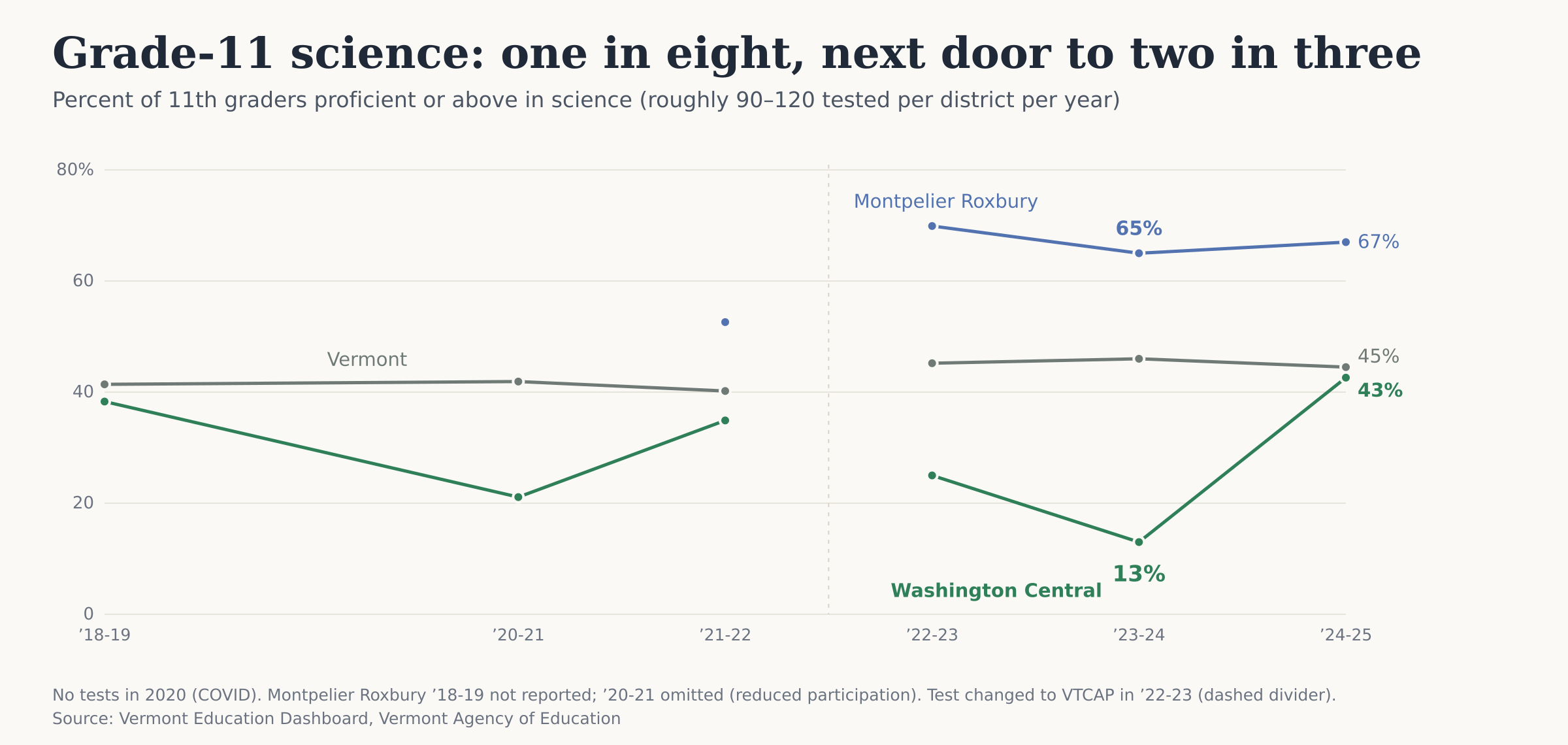
Washington Central runs seven to eleven points ahead of a Vermont average that has itself fallen behind the country. Read against the nation, the district's standing shrinks on most measures — and adjusted for the community it serves, its national test standing is now average.
An honest look at Washington Central and its peers
Fifteen Vermont systems are about Washington Central's size, with similar incomes and a similar share of low-income students. Compared with them, three problems stand out at every group size — and an editor's note revisits the fourth.
August 11: vote like our kids' education depends on it
There will be a district-wide ballot question on August 11 — a vote on who gets to participate in decisions about our schools. This is a question about whether we will fulfill our obligation to our district's students and make use of every option available to us.
Cutting the medicine, not the management
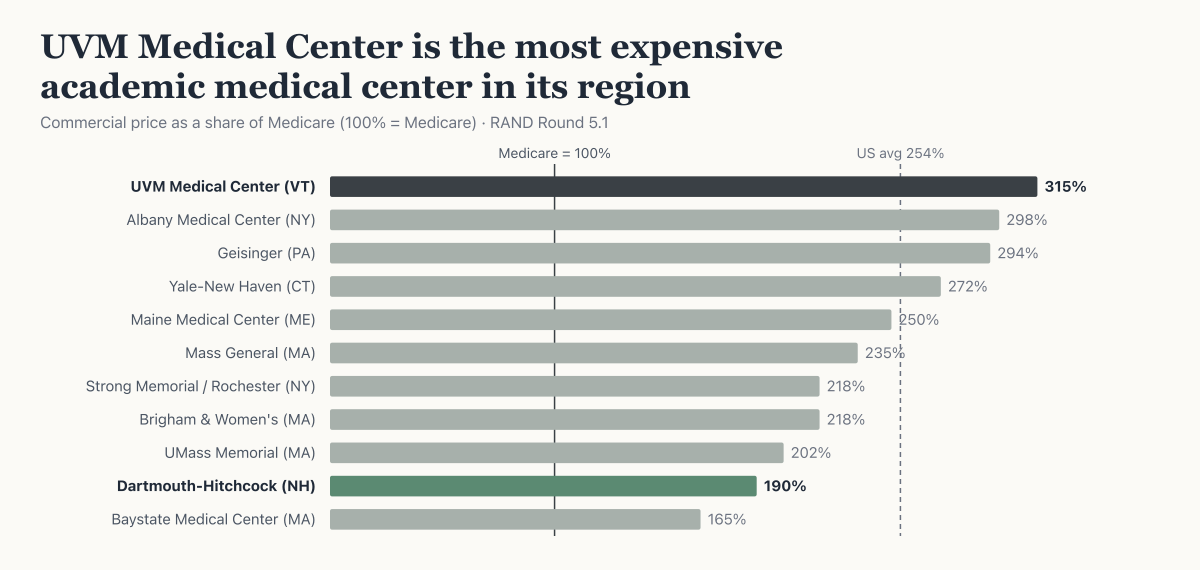
UVM Medical Center is losing about $460,000 a day, and the health network's answer is to lay off staff, order its doctors to see more patients an hour, and strip weight-loss drugs from its own employees' insurance. None of those moves touches the two cost drivers Vermont's hospital regulator — and the consultant the network itself helped pay for — have identified in writing: a top-heavy administration, and a decade of Vermont premium-payers subsidizing money-losing hospitals across the lake in New York.
Save before you spend: a capital-funding strategy for Middlesex
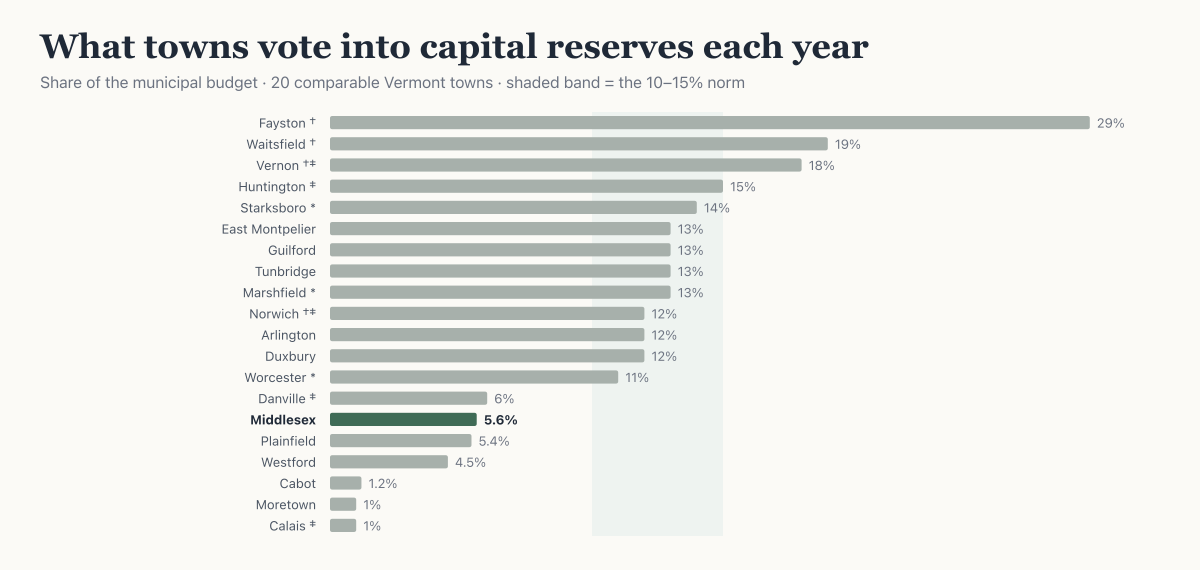
Middlesex borrows at nearly 6 percent for equipment that neighboring towns buy outright. A disciplined shift toward pre-funding would cut the town's interest bill, replace tax spikes with a level annual line, and rebuild the emergency reserves the 2023–24 floods washed away. The evidence from twenty comparable Vermont towns — and from the profession's own standard-setters — says it is affordable, and that the town is already halfway there.
A petition, a statute, and a refused vote: how Washington Central's board declined to warn a special meeting its voters petitioned for
Constrained school funding turned a single town's closure vote into a district-wide question. A petition asked all five towns to decide it. The board, advised it had no choice, declined to schedule the vote.
2 Issues & 4 questions for June 2026 in Middlesex
Notes from the June 16th Selectboard meeting: a petition to upgrade South Bear Swamp Road from Class 4 to Class 3, Russ Bennett's CHIP-funded Colby Road proposal, and what each means for who can afford to live in town.