There will be a school district ballot question voted on August 11th. This vote will be held by Australian ballot. A minority of the Board worried it might have to be done by floor vote, though State law appears clear that it doesn't. The official warning — with the exact ballot language — must be posted roughly by July 12 (30–40 days before the vote); watch for it.
(Paraphrased) the ballot question is: Shall the WCUUSD school district amend Article 4(B) of its articles of agreement such that all voters in the district will be included in a vote to close a school? (Articles of Agreement).
4(B) currently states:
In academic year 2021-2022 and after, the New Union District Board shall not close any school building or cease using the building to provide direct instruction in at least one grade, prekindergarten through grade 12, unless first approved by both a majority of the Union District Board and the voters residing in the town in which the school is located.
To be clear: a yes vote closes no school. It changes who participates in any future closure decision — all five towns' voters, rather than the host town's alone — and the voters are not the only check: the Board must still separately approve any closure.
Some history worth knowing: the host-town rule was our choice, not the state's. When the State Board ordered the merger in November 2018, the template articles it provided would have put closure decisions to all of the district's voters. Before the articles were adopted, that language was amended into today's Article 4(B) — host-town approval — and that has been the rule from the district's first day. Notably, board members involved at the time disagree on whether it was generally known that the town-only restriction had been added. August 11 asks the district's voters whether to return to district-wide participation.
The short version of how we got here: in December, staring at a budget over the state's spending-penalty threshold, the board recommended closing Calais Elementary and Doty Memorial, and sent each closure to the host town as Article 4(B) requires. On February 10 both towns said no — Calais 398–249, Worcester 212–114. In May the district announced a shared-schools reconfiguration — without a board vote — that would move Rumney Memorial's (Middlesex) 5th and 6th graders to Doty in Worcester. In June, more than 500 voters petitioned for this amendment vote; state law says the board "shall" call a petitioned special meeting, and after controversy, this past Wednesday (July 8th) the board voted by a simple majority to warn the vote for August 11th.
What problem does this petition try to fix?
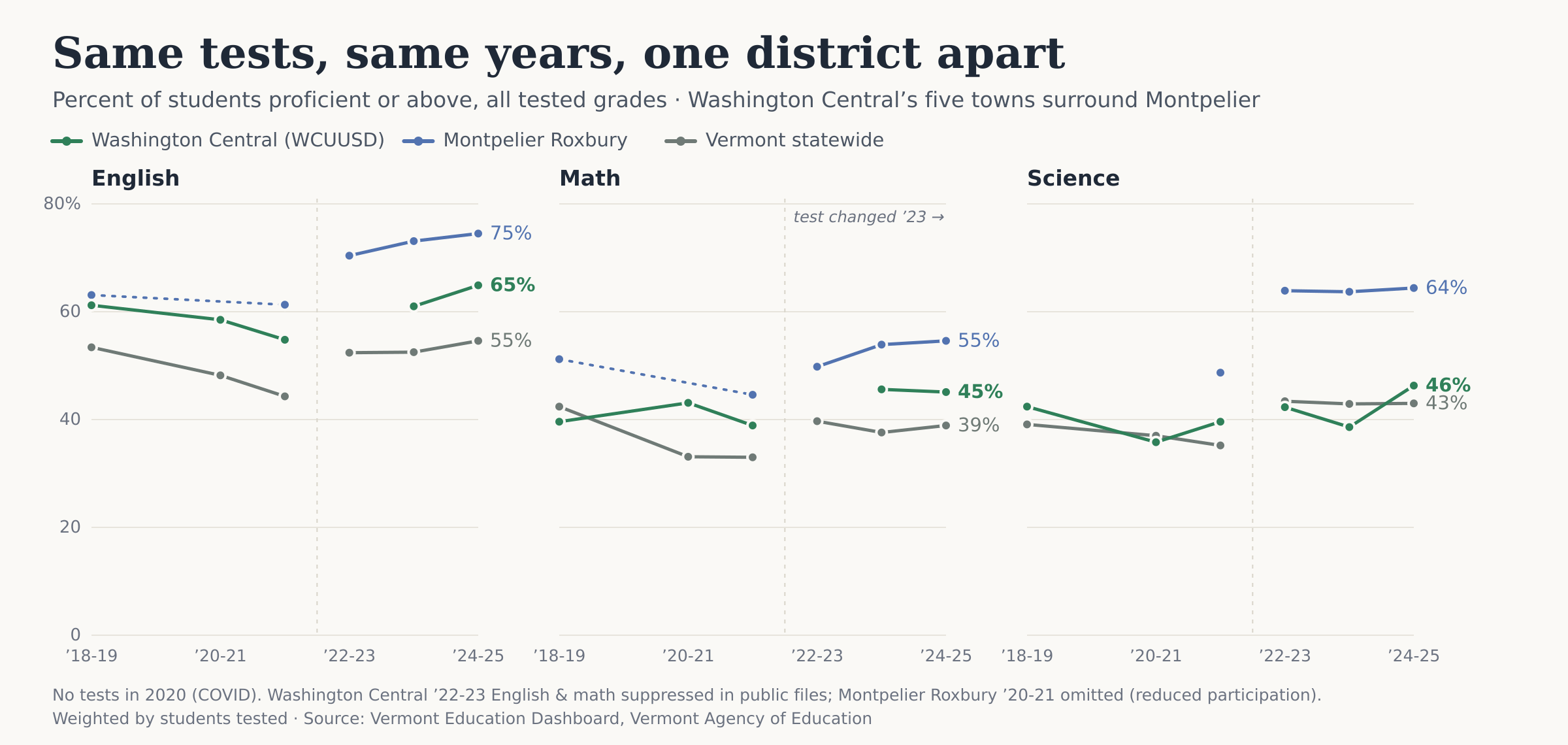
U32 student outcomes are falling behind — and you don't need an abstraction to see it. Montpelier Roxbury, the district next door (same Act 46-era union, same tests, same years), has been pulling away from us since the union:
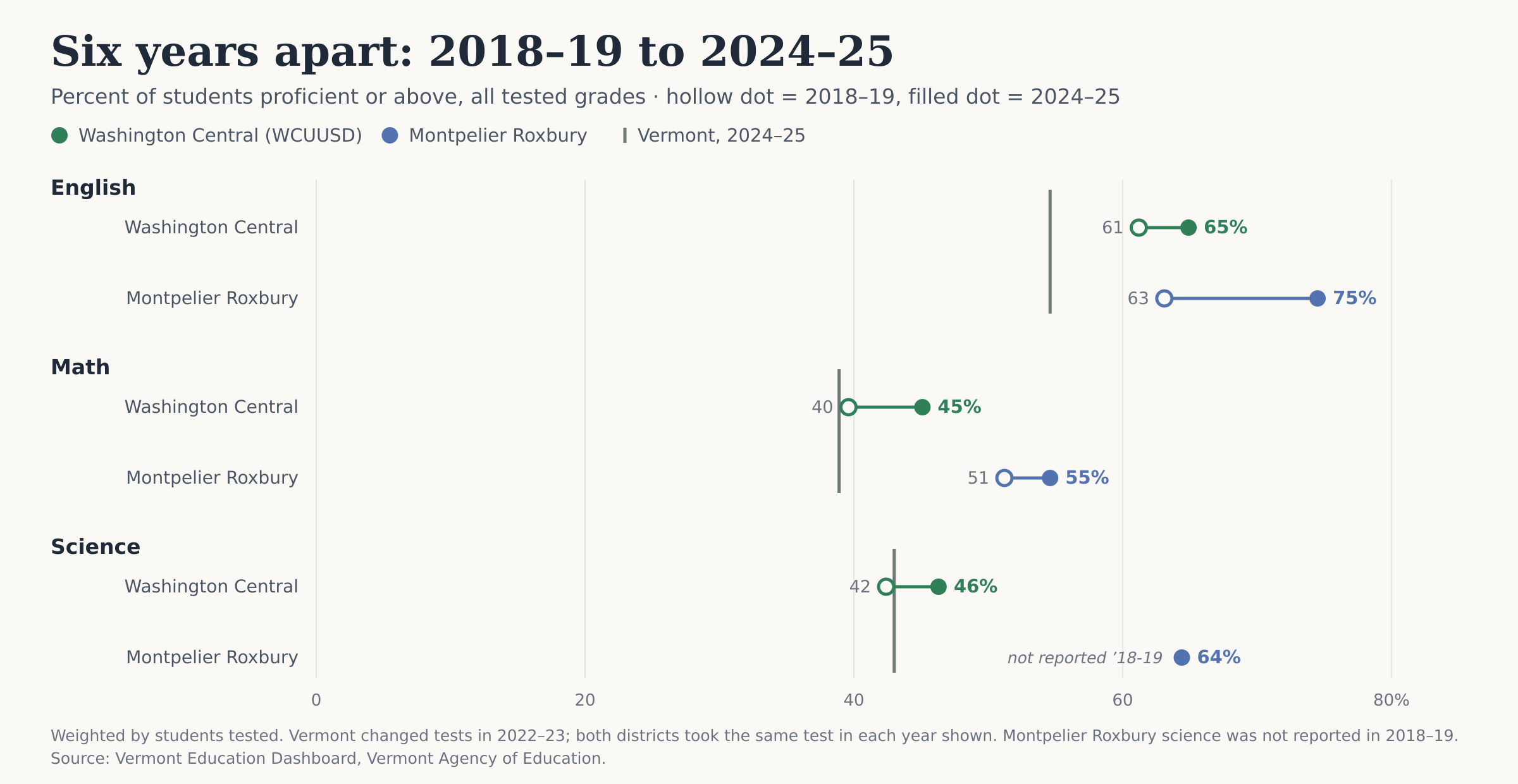
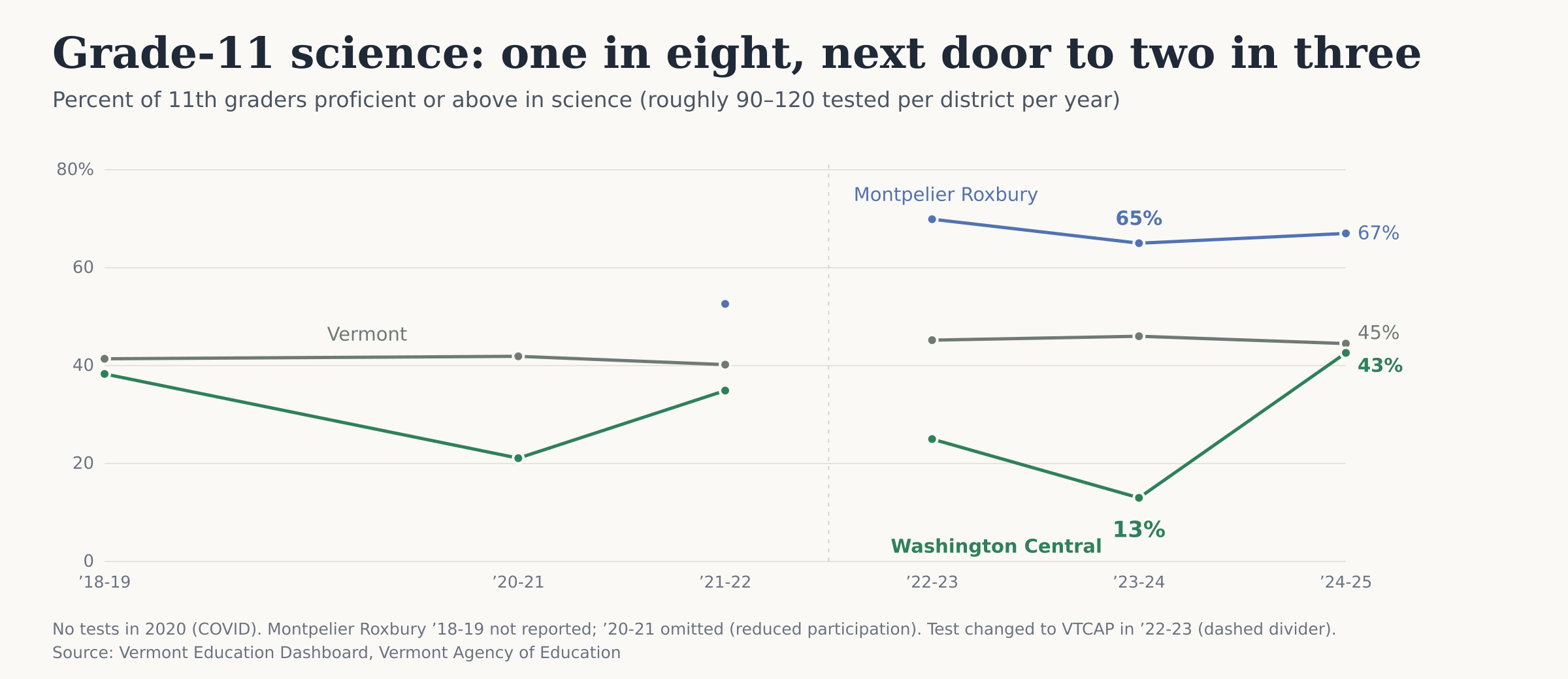
In 2018–19 we were essentially tied with Montpelier in English; today they are ten points ahead. In math they have held a roughly ten-point lead the whole way (U-32's math scores sat below the grade-matched state average every year before the union, too). Sharpest of all: our eleventh graders went from 38% proficient in science in 2019 to 13% in 2024. One in eight of our juniors proficient in science, fifteen minutes from a school where it is two in three.
Source: Vermont Education Dashboard, Vermont Agency of Education
Our Washington Central Unified Union School District is failing: our students' test outcomes are worse than our towns' demographics say they should be — adjust Montpelier's results to match our income mix, and a district like ours should be scoring about 71% in English; we scored 65. In some years and subjects, students that do not qualify for free lunch have worse outcomes than those who do — in 2024, non-free-lunch juniors scored 10% proficient in science against 18% for free-lunch juniors — so the hypothesis I heard from a WCUUSD board member Wednesday — that scores are falling because we don't fund enough extra help for low-income kids — doesn't make sense.
As I’ve previously written, just like in Vermont’s healthcare problem, WCUUSD is paying more for district administration than it ever has — Superintendent Services alone is up roughly 50% since FY23 — over the same years its test scores fell.
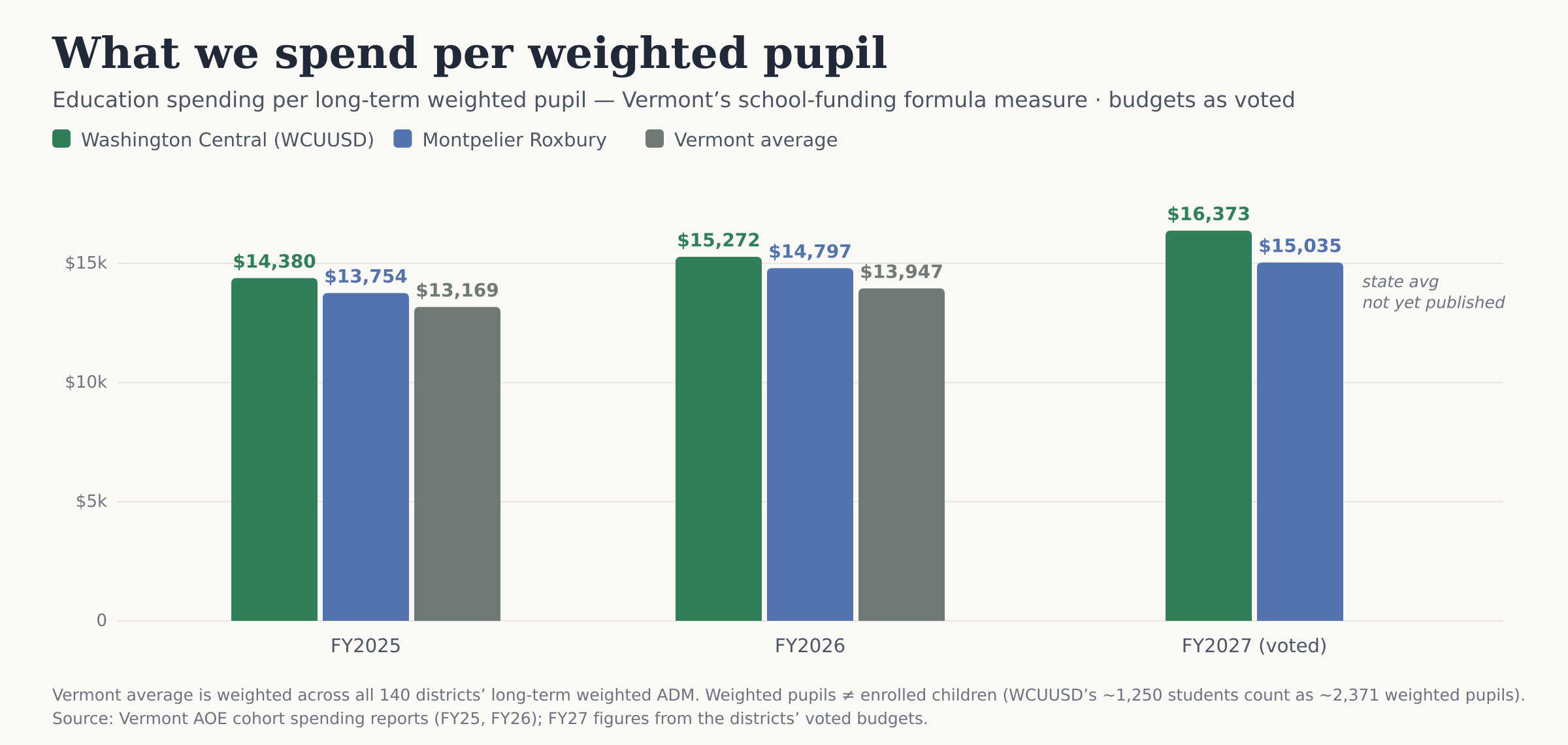
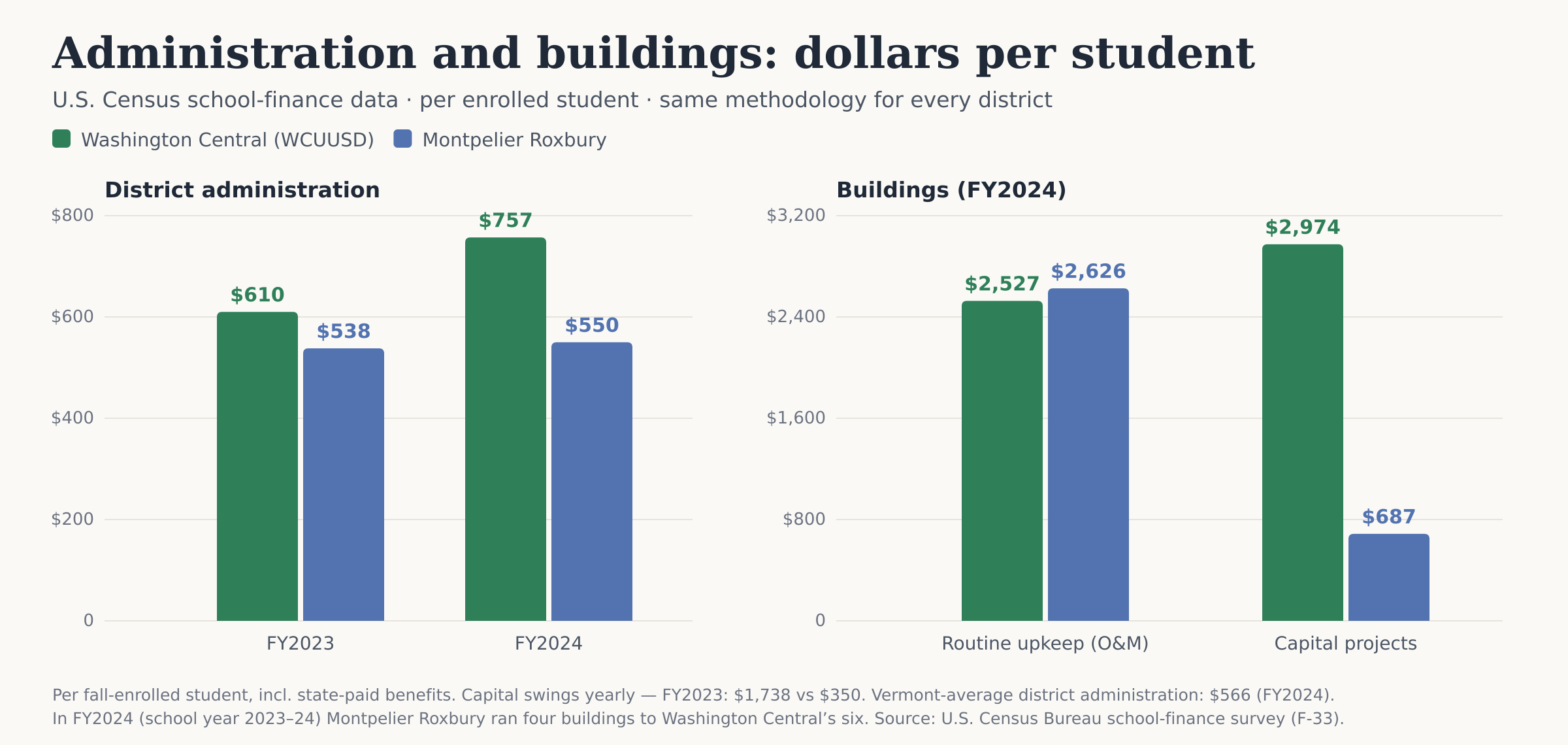
Montpelier Roxbury doesn't pay nearly as much per student, and has better student outcomes. On the U.S. Census's school-finance data — the same methodology for every district in the country — Washington Central spent $757 per student on district administration in FY2024 to Montpelier Roxbury's $550, and the gap is widening: a year earlier it was $610 to $538. (The Vermont average is $566 — itself far above the national $351.) Our own budget books say it more plainly: in the budgets voted this March, our central office runs about $1,817 per student; Montpelier's board, superintendent and business office together, about $1,030 — their entire superintendent-and-board line costs less than our Superintendent Services line alone. Buildings tell the same story from another angle. On routine upkeep, the two districts spend about the same per student — $2,527 here, $2,626 there — but ours is stretched across six buildings while Montpelier runs three. On capital repairs, we spend more than four times as much: $2,974 per student against their $687, keeping aging, half-empty buildings standing. And the bottom line under Vermont's school-funding formula: Washington Central spends $16,373 per weighted pupil this year, Montpelier Roxbury $15,035 — a comparison Montpelier's own budget flyer prints.
What does this have to do with a petition to change how schools are closed? Given we, everyone in the district, are failing our children, all options need to be on the table to right our course. That includes closing schools, and cutting district administrative bloat.
I have spoken with a couple of opponents of closing schools. Their concern is the impact closure will have on the community as a place for all ages to meet together. I do not hear concern for our children and the clear, persistent failure of all of us to provide them with good educational and social outcomes. Education dollars need to be spent on education services, not re-routed to non student population use.
The fairest objection I've heard is different: the host-town rule has been there since the district's founding, and Calais and Worcester used it in February — so changing it now feels like changing the rules after the game. But remember why a majority of the board recommended closures in the first place: so that our schools could staff basic functions full-time — a school nurse in the building — and stop subjecting young children to more location, teacher and staff disruptions than necessary. The objection is a town-rights objection, and I understand it. But the reason we pay an education tax and run an education system is the growth and well-being of our children. The same articles that contain the host-town rule contain the lawful process for amending it, and more than 500 of our neighbors invoked that process. Rules we adopted together can be revisited together, and should be revisited when they are not in the best interests of our district students.
Let's not conflate two problems – lack of social centers and failure to provide for our children. Let's address each on its merits.
My personal take
The best solution would be for our students’ test scores to be above the state average — which is where our demographics say they should be — and for every town to have an elementary school. But the 91 third graders, 87 fourth graders and 83 fifth graders who took the English state test in 2025 do not require five schools. Each grade barely warrants 5 classrooms! Given these population facts and the falling outcomes, what do we change?
I have a 4 and a 2 year old. I want them to have the consistency of the same school staff in elementary school, and the same school building. Disrupting the 4th and 5th grades with a school move is a recipe for terrible attention and social disruption in incredibly important preparation years. I predict it will make our test scores worse five years from now.
I live close to I-89 in Middlesex. It’s faster for my kids to get to school in Berlin — passing through an entire separate school district, Montpelier's, on the way — than to Rumney. Our school locations (let alone school districts) make absolutely no sense by any rubric that prioritizes student outcomes. The towns that built and participated in these elementary schools are not the towns we have today. I’d be ok with Rumney being closed. Obviously, folks that live on the opposite northern end of Middlesex would likely disagree – but Doty is only 10 more minutes heading north from Rumney! The question isn't which schools we close -- it's how we allocate education funding so we get the outcomes our kids need, with appropriate pay for teachers and administrators and funds for upkeep.
We don’t need 5 elementary schools. We don’t have the kids for 5 elementary schools. Our kids aren’t thriving – academically or socially – and it is our obligation to ensure they do. And most pressing: the state is not giving us enough money to fund 5 elementary schools (nor is there any rational argument focused on educational needs for the state to do so).
We need to be adults, we need to put the children first, and we need to do our jobs and spend our education dollars wisely, so that all of our children get a good public education and become outstanding, productive new Vermont citizens — which the state sorely needs more of.
How to vote: You vote in your own town, at your usual polling place, on the same day as the state primary — and you can cast the school-district ballot without taking a primary ballot. Once the warning is posted, absentee ballots for the district question can be requested from your town clerk.
A note on the data: figures are from the Vermont Education Dashboard and AOE dataset files, weighted by students tested. Vermont changed tests in 2022–23, so same-year district comparisons are cleaner than across-year trends. Washington Central's 2022–23 English and math are suppressed in the public files; Montpelier Roxbury's 2020–21 results reflect reduced COVID-year participation. Grade-11 science rebounded to 42.6% in 2024–25 — a thirty-point single-year swing on about 110 test-takers; that cell is volatile in both directions. Spending figures come from the U.S. Census Bureau's school-finance survey (per enrolled student, same method for every district), the districts' own budget books, and Vermont's per-weighted-pupil formula — three different yardsticks, each compared only like-for-like.